
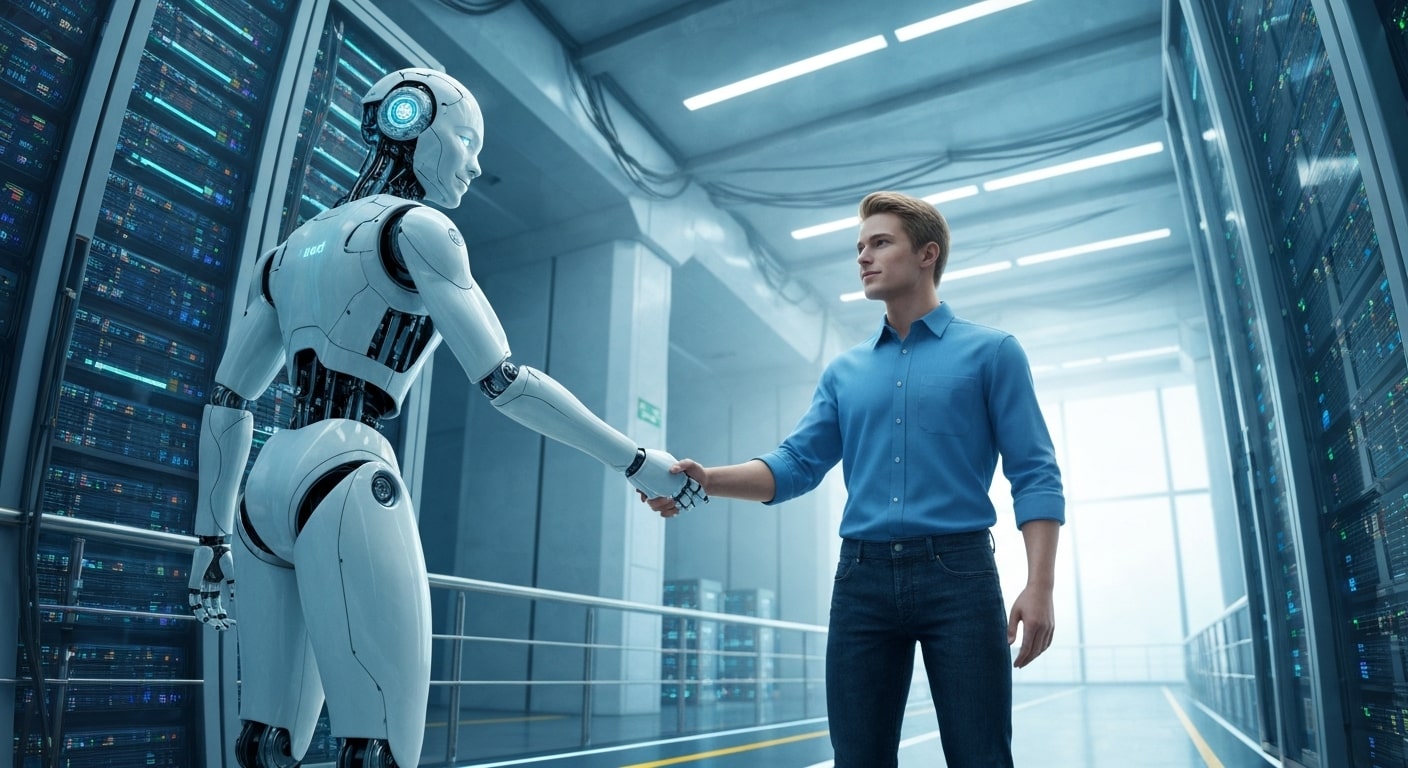

What People Often Get Wrong About AI Replacing Humans
-
AI can handle repetitive tasks, sort through large amounts of data, and speed up work that used to take hours, but it still works best as a support tool. A marketer might use AI to draft ad variations, or a business owner might use it to summarize customer feedback, but the final judgment still comes from a person who understands the goal, the audience, and the real-world context.
-
Even the most advanced AI systems don’t think, feel, or understand consequences the way humans do. They can predict patterns and generate convincing answers, but they don’t have emotional intelligence, lived experience, or common sense in the human way. That matters when decisions involve trust, safety, money, health, or people’s livelihoods.
-
Human oversight is what keeps artificial intelligence useful instead of risky. Someone still needs to check the facts, catch biased outputs, protect private data, and decide whether an AI-generated recommendation actually makes sense. Without that layer of review, even a helpful tool can create problems fast.
-
AI technology also isn’t locked away inside big tech companies anymore. Freelancers, small businesses, teachers, creators, and everyday workers are using AI tools to write faster, design visuals, organize research, and automate simple workflows. The real advantage now belongs to people who learn how to use these tools well, not just companies with massive budgets.
-
The idea that AI will wipe out every human job is too simple. Some tasks will change, and some roles will shrink, but new opportunities are already forming around AI strategy, prompt writing, content review, automation management, data quality, compliance, and human-centered creative work.
-
AI still needs human intervention to stay fair, secure, and accurate. If the training data is flawed, the output can be flawed too. If sensitive information is handled carelessly, privacy risks grow. That’s why businesses using AI need clear rules, strong data protection, and people who know when to trust the system and when to step in.
Why So Many People Misunderstand Artificial Intelligence
Artificial intelligence seems to be everywhere right now. One day it’s AI-generated images flooding social media, the next it’s headlines about chatbots replacing jobs or machine learning changing entire industries. With so much noise online, it’s easy for myths and exaggerated claims to spread faster than the facts. Some people think AI can think like a human already, while others believe it’s about to replace every job overnight.
The reality is usually more nuanced than the headlines make it sound. AI is powerful, no question, but a lot of the conversation around it mixes real breakthroughs with fear, hype, and misunderstanding. This article breaks down some of the most common myths about artificial intelligence, explains what AI can actually do today, and clears up where human involvement still matters more than ever.
Understanding Artificial Intelligence: Concepts and Capabilities
At its core, artificial intelligence is a field of computer science focused on creating systems that can mimic human intelligence to perform tasks. This AI technology can process vast amounts of information, recognize patterns, and make predictions based on data.
Unlike human intelligence, which involves consciousness and emotion, AI operates based on algorithms and data. (Learn The 3 Types Of AI Intelligence Here >>>) It's a tool designed to augment what we do, making processes more efficient and providing valuable insights. To understand its true potential, we must first look at what AI is and how it has evolved.
What AI Is (and Isn't): Definitions and Real-World Uses
So, what are we actually talking about when we discuss artificial intelligence? It's a broad branch of computer science where machines are programmed to perform tasks that typically require human intellect. Instead of being a single, all-knowing entity from science fiction, AI is a collection of different technologies, including machine learning and deep learning, each with specific functions. Many of the most common myths about AI stem from a misunderstanding of these basic definitions.
You likely interact with AI every day without even realizing it. These use cases are already integrated into our digital lives, helping to simplify tasks and provide personalized experiences.
- Search engines using algorithms to find the most relevant results
- Streaming services recommending shows based on your viewing history
- Email platforms that suggest text as you type
- Customer service chatbots that handle simple inquiries
These examples show that AI isn't some far-off concept; it's a practical tool already at work. It excels at specific, repetitive tasks but is not a magical solution that can fix any business problem on its own.
How AI Technology Has Evolved Over Time
The idea of AI technology isn't new. While the recent rapid rise of generative AI has brought it into the spotlight, its roots go back to the 1950s. The journey from theoretical concepts to practical applications has been long, marked by significant breakthroughs in the development of algorithms and computing power. This long history has been filled with both excitement and skepticism.
Public views about technology have often been shaped by AI's portrayal in popular culture, which has influenced the spread of myths. The evolution of AI, however, is grounded in decades of research. The "AI boom" of the 1980s saw deep learning techniques take root, aiming for machines capable of learning from mistakes. Today, we see the results in countless business and consumer applications.
This progression shows a steady move toward more sophisticated systems. Here is a simplified look at its timeline:
| Era | Key Development |
|---|---|
| 1950s | Alan Turing publishes "Computer Machinery and Intelligence," laying the theoretical foundation. |
| 1980s | The "AI boom" popularizes research and deep learning techniques gain traction. |
| 2020s | Generative AI models like ChatGPT become mainstream, accelerating public awareness and adoption. |
Debunking Popular Myths About Artificial Intelligence
With the incredible power of AI comes a wave of common myths, often fueled by science fiction and exaggerated headlines. These misconceptions can create fear or, on the other hand, unrealistic expectations about what this technology can achieve. It's important to ground our understanding in reality to make informed decisions.
Let's separate truth from fiction by addressing some of the most persistent myths head-on. By looking at the facts, you can get a clearer picture of AI's true capabilities and limitations, helping you see where it can genuinely add value.
Myth 1: AI Will Replace All Human Jobs
One of the biggest fears surrounding AI implementation is that it will lead to mass unemployment by replacing all human jobs. While it's true that AI will automate certain routine tasks, history shows that disruptive technologies tend to transform the job market rather than eliminate it. The truth is that AI is more of a collaborator than a competitor.
AI excels at handling repetitive, data-heavy work, which frees up people to focus on tasks that require uniquely human capabilities like creativity, critical thinking, and strategic planning. The World Economic Forum even predicts that while some jobs will be displaced, AI will create millions of new roles focused on data analysis, AI development, and system management.
Instead of a replacement, think of AI as a tool that augments human work.
- AI handles: Data processing, customer inquiries, and supply chain optimization.
- Humans handle: Complex problem-solving, emotional connection, and innovative design.
- The result: A more dynamic and productive workforce where people and machines work together.
One of the biggest myths about artificial intelligence is that it’s going to eliminate every career path, but that’s not what’s happening in the real world. Businesses still need people who can think creatively, build relationships, make judgment calls, and understand human behavior. In fact, many industries are already seeing new opportunities open up because of AI, especially for workers who know how to use the technology instead of ignoring it. That shift is exactly why more professionals are paying attention to the careers expected to grow and thrive alongside artificial intelligence as automation becomes part of everyday work.
Myth 2: AI Can Think and Feel Like a Human
It's a common trope in movies: a machine that develops consciousness and emotions. But is it true that AI can think and feel like humans? In reality, the answer is no. While AI can mimic human intelligence with incredible accuracy, it doesn't possess genuine consciousness, motivations, or emotional intelligence. Its processes are fundamentally different from the workings of the human brain.
AI systems operate on algorithms and data. They learn to recognize patterns and make decisions based on the vast amounts of information they are trained on. However, they do not experience feelings or have subjective thoughts. An AI can be programmed to identify and respond to human emotions, but it doesn't feel them itself.
This distinction is crucial. AI lacks the empathy, creativity, and critical thinking that come from lived experiences. Sentient AI that can truly think and feel for itself remains firmly in the realm of science fiction. The technology we have today is a powerful tool for analysis and automation, not a conscious being.
Myth 3: AI Operates Without Any Need for Human Oversight
Another prevalent myth is that an AI solution, once deployed, can operate entirely on its own without any human intervention. This idea is not only inaccurate but also dangerous. AI systems are powerful, but they are not infallible. They are built, trained, and maintained by human experts and reflect the choices made during their development.
Without careful guidance, AI can make errors, reproduce human biases present in its training data, or fail to understand the context of a unique situation. This is why human oversight is essential for ensuring an AI's relevance, reliability, and ethical operation. For example, a chatbot needs a clear path to escalate complex a customer service issue to a human agent who can handle nuance and empathy.
Human involvement is also critical for data security and accountability. In fields like healthcare or finance, human-in-the-loop systems are necessary to validate AI-driven decisions and intervene when the system encounters an ambiguous scenario. AI augments human decision-making; it does not replace the need for it.
A lot of people still assume AI-generated images are just experimental tools for tech enthusiasts, but major companies are already using them in real marketing campaigns. Brands are creating product mockups, ad creatives, social media visuals, and promotional content faster than ever by blending AI tools into their creative process. In many cases, consumers never even realize the images were generated with artificial intelligence, which says a lot about how quickly the technology is improving. That growing shift is why more marketers and creators are watching how large brands are using AI-generated images to increase engagement and scale content production across digital campaigns.
The Realities Behind AI Capabilities and Limitations
To truly harness the potential of AI, you need a realistic view of its capabilities and limitations. It's not a magic wand that solves every problem, but it is a transformative tool when applied strategically. Understanding where AI excels-and where it falls short-is the key to unlocking real business value.
AI is powerful for processing data and automating tasks, but it relies on the data it's given and the rules it's taught. Let's explore some of the practical realities of using AI, from its data needs to its learning processes, to help you form a clear and effective strategy.
How Much Data Does AI Actually Need?
A common misconception is that all AI systems require massive amounts of data to function, similar to the large datasets used to train models like ChatGPT. While some complex models do need enormous volumes of training data, this isn't a universal rule. The amount of data an AI needs depends entirely on the specific problem you are trying to solve.
For many business problems, a more focused dataset is not only sufficient but often more effective. Your data readiness depends on the AI use case you want to implement. For instance, an AI designed to forecast demand for a specific product line may not require the same massive datasets as a general-purpose language model.
Furthermore, the idea that you need "perfect" data is also a myth. A key advantage of AI is its ability to work with unstructured and complex data from existing systems. With a strategic framework, you can determine where and how to prepare your data for a specific AI application, making the technology more accessible than many believe.
Are All AI Systems Truly Autonomous and Self-Learning?
The term "self-learning" often creates the impression that AI systems can learn and evolve on their own, like a human. However, are all AI systems capable of learning entirely on their own? The reality is more nuanced. While technologies like deep learning and artificial neural networks allow AI to adapt, this process is not truly autonomous.
AI's learning is based on recognizing patterns in the data it is fed. Neural networks are designed to mimic the structure of the human brain, allowing them to interpret complex information and improve their performance over time. However, this learning is confined to the specific task they were programmed for and the data they have access to.
An AI doesn't learn from experience or develop new ideas in the way humans do. It adapts through learned patterns and interpreted data. These systems still require humans to update their training data, adjust their algorithms, and validate their outputs to ensure they remain accurate and relevant. True autonomous learning remains a goal, not a current reality.
Understanding AI Starts With Looking Past the Hype
At the end of the day, a lot of the fear and confusion around artificial intelligence comes from people only seeing the extremes. One headline says AI will replace everyone. Another claims it’s smarter than humans already. The truth usually sits somewhere in the middle. AI is powerful, and it’s changing the way people work, create content, market products, and analyze information, but it still depends heavily on human direction, oversight, and decision-making.
The more you understand what artificial intelligence can realistically do today, the easier it becomes to separate marketing hype from reality. That matters whether you’re a business owner exploring automation, a creator using AI tools for content, or someone simply trying to figure out what’s real online anymore. And with AI-generated images becoming more convincing every month, a lot of people are realizing they’re not as good at spotting synthetic content as they thought. That’s part of the reason interactive tools like the AI image spotting game at AiorNot.US have started gaining attention as a hands-on way to test how well people can identify real photos versus AI-generated images.
Frequently Asked Questions
Is AI Only Useful or Accessible for Large Tech Companies?
Not anymore. While AI technology once required deep pockets, the rise of cloud-based platforms and pre-built solutions has made it accessible to businesses of all sizes. This "democratized AI" allows organizations to solve specific business problems and implement a relevant AI use case without massive upfront investments in infrastructure.
Why Do Some People Think AI Is Dangerous or Uncontrollable?
Fears about AI technology often come from science fiction portrayals of machines turning against humanity. In reality, concerns are more focused on practical issues like AI bias, a lack of transparency, and data security risks. Without proper human oversight and ethical guardrails, AI can produce unintended and harmful results, diminishing its business value.
How Have AI Myths Shaped Public Perception and Business Decisions?
A common misconception, often amplified by social media, can distort public perception and lead to poor business decisions. For example, believing AI is a "magic bullet" has caused some businesses to invest in it without a clear strategy, leading to failed projects. Conversely, unfounded fears have caused others to avoid AI entirely, missing out on its potential business value.