
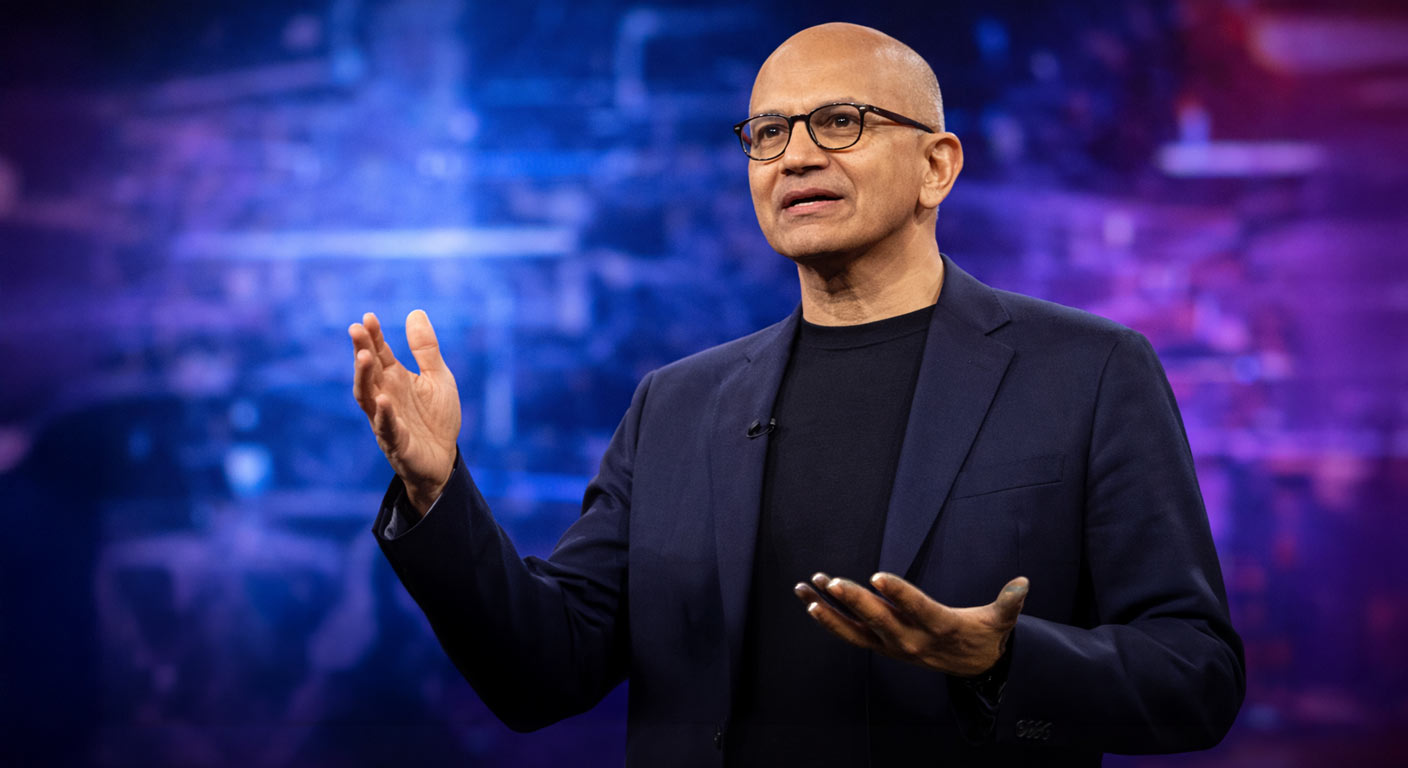

Microsoft CEO Satya Nadella discussing AI agents and the future of work.
In conversations about artificial intelligence, it's easy to get swept up in hype cycles-new models, bigger benchmarks, and dramatic predictions about job losses or sentient machines. What makes this discussion with Satya Nadella different is its grounding. Rather than focusing on flashy demos alone, Nadella frames AI as an architectural shift in how software, work, and the web itself will function over the next decade.
In this wide ranging interview, Nadella outlines Microsoft's vision for an “agentic” future, one where AI agents don't just answer questions but actively coordinate tasks, reason across systems, and work alongside humans in meaningful ways. The conversation touches on AI agents, enterprise software, the changing nature of work, and why the web itself may need to be rebuilt for this next era. Here is a more detailed look at AI agents explained, we define The types & provide examples for our readers.
The Shift From Tools to Agents
One of the core ideas Nadella returns to repeatedly is the distinction between AI as a tool and AI as an agent. Tools respond to prompts; agents act with intent. They can be delegated goals, break those goals into steps, and interact with multiple systems to achieve outcomes.
This shift matters because it changes how humans interact with software. Instead of clicking through interfaces, copying data between apps, or manually coordinating workflows, users increasingly describe what they want done and supervise the process. The agent becomes a collaborator rather than a feature.
What the “Agentic Web” Really Means
Nadella introduces the idea of an agentic web an internet designed not just for humans browsing pages, but for AI agents negotiating, retrieving, and acting on information across platforms.
In today's web, data is often siloed behind interfaces built for human consumption. In an agentic future, APIs, permissions, and identity become first-class citizens, allowing agents to securely access information, perform actions, and coordinate across services.
This doesn't mean humans disappear from the loop. Instead, humans define intent, constraints, and oversight, while agents handle execution at machine speed, but can AI be Conscious? we take a deep dive into the uncomfortable question
AI Agents Inside the Enterprise
Much of the conversation focuses on enterprise use cases, where Nadella sees immediate value. In large organizations, knowledge work is fragmented across documents, meetings, spreadsheets, and systems. AI agents promise to stitch that context together.
Imagine an agent that prepares for meetings by reading relevant documents, summarizing prior decisions, and tracking action items across teams. Or an agent that monitors business metrics and proactively flags anomalies before humans notice.
Nadella emphasizes that this is less about replacing workers and more about amplifying them. The real productivity gains come from reducing cognitive overhead-the mental tax of switching contexts and managing complexity. He also makes it clear you should not fear AI replacing people, adapt & thrive instead as we are living in a very promising time for tech.
The Future of Knowledge Work
A recurring theme is how knowledge work itself will evolve. Nadella suggests that many professionals will transition into roles that look more like “agent managers”. Instead of doing every task manually, they'll define objectives, review outputs, and guide decision-making.
This mirrors earlier shifts in computing. Just as spreadsheets didn't eliminate accountants but changed how they worked, AI agents won't eliminate knowledge workers they'll change the shape of their day-to-day responsibilities.
Why Reasoning and Memory Matter
Nadella is careful to note that not all AI systems are created equal. For agents to be useful, they need more than language generation. They need reasoning capabilities, memory, and the ability to maintain context over time.
This is where the conversation moves beyond simple chatbots. An effective agent must remember prior interactions, understand goals, and adapt as conditions change. Without these qualities, AI remains reactive rather than proactive.
Rebuilding Software for an AI-First World
Another major point is that AI isn't just a new feature layered onto existing software. It requires rethinking software architecture from the ground up.
Traditional applications were built around rigid workflows and static interfaces. AI-native systems are more fluid, conversational, and adaptive. They rely on models, orchestration layers, and feedback loops rather than fixed logic.
Nadella argues that this transition will take time. Organizations that treat AI as a bolt-on tool may miss its deeper potential. Those that rethink processes end-to-end stand to gain the most. A Simple Guide To ChatGPT That Anyone Can Understand
Human Judgment Still Matters
Despite the excitement around automation, Nadella repeatedly stresses the importance of human judgment. AI agents can propose actions, surface insights, and execute tasks, but humans remain responsible for values, ethics, and final decisions.
This framing pushes back against both utopian and dystopian narratives. AI is neither a magic solution nor an existential threat-it's a powerful amplifier of human intent. How it's used depends on the systems, incentives, and oversight we build around it.
What This Means for the Broader AI Landscape
Zooming out, this conversation reflects a broader shift in AI discourse. The focus is moving from model capabilities alone to systems thinking. How models integrate with data, workflows, and human decision-making matters just as much as raw performance benchmarks.
For builders, this means designing with humans in the loop. For businesses, it means investing in change management, not just technology. And for society, it means grappling with how work, responsibility, and value creation evolve.
Why This Conversation Matters Now
At a moment when AI headlines swing between hype and fear, Nadella's perspective offers a grounded roadmap. It acknowledges rapid progress while emphasizing the hard work still ahead.
The future he describes isn't one of sudden replacement, but of gradual transformation-where AI agents become part of the fabric of daily work, quietly reshaping how tasks get done.
Key Takeaways
- AI is shifting from reactive tools to proactive agents.
- The web and enterprise software will need to evolve to support agent-based interaction.
- Knowledge workers are likely to become supervisors of AI-driven workflows.
- Reasoning, memory, and context are critical for useful AI agents.
- Human judgment and oversight remain central in an AI-first world.
This discussion doesn't promise easy answers, but it does offer clarity. AI's future isn't just about smarter models-it's about smarter systems, thoughtful design, and a clear understanding of what humans want machines to help us achieve.
Learn To Spot AI Like Satya, By Playing The AI Image Guessing Game @ AiorNot.us