
What This Article Covers
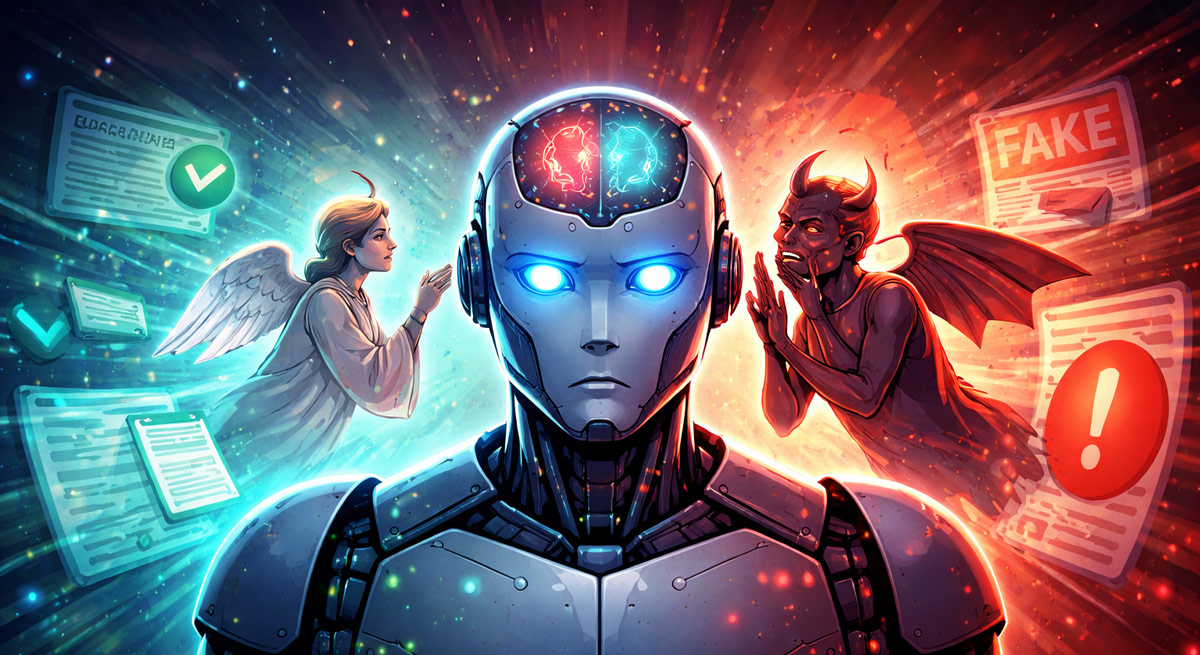
People ask, "Can AI lie?" because they've seen it happen: a chatbot cites a fake source, invents a statistic, or confidently explains something that isn't true. In this editorial-style guide, we'll break down:
What it really means for AI to "lie" (and why that's not quite the right word)
How AI hallucinations happen and why they sound so believable
How hallucinations become misinformation at scale
When it's accidental vs. when it's shaped by training and incentives
How to spot hallucinations and reduce them in real use
If you want the beginner version first, start with our dedicated explainer: What is AI hallucination and why does it happen?
Can AI Actually "Lie," Or Is It Something Else?
A lie is usually intentional. It assumes a mind that knows the truth and chooses to say something different. Most AI models today don't have intent, beliefs, or a personal agenda. They generate outputs by predicting the most likely next words based on patterns learned from training data.
So when people say "AI is lying," what they often mean is: AI is producing information that is false, but phrased as if it's true. That mismatch-false content delivered with confidence-is what makes hallucinations so dangerous.
Still, the phrase "trained to lie" isn't totally off-base, because the system can be optimized to prioritize: usefulness, fluency, persuasion, and "sounding right"-even when the model is uncertain. In other words, the system can be trained to speak with confidence under ambiguity. That looks a lot like lying, even if it isn't conscious deception.
What Are AI Hallucinations, In Plain English?
An AI hallucination happens when a model outputs something that is not grounded in facts: it invents a detail, a quote, a medical claim, a legal rule, a date, a person, or a source. Sometimes it's subtle-like swapping a number or misattributing a study. Sometimes it's dramatic-like generating a full bibliography of papers that don't exist.
Hallucinations are not always random. They often follow the model's internal "best guess" based on: common patterns, typical phrasing, and plausible-sounding structure. If you've ever read something and thought, "This sounds legit," only to find out it's wrong-welcome to the problem.
We cover the deeper mechanics of this in our Understanding AI section: Understanding AI: how models learn, why they fail, and how to think about them.
Why Hallucinations Sound So Convincing
1) Fluency masquerades as truth
Humans are wired to equate smooth language with competence. If something is written clearly and confidently, our brains give it a credibility boost. AI models are exceptionally fluent. That fluency can be helpful for summarizing known facts, but it becomes a trap when the model is guessing.
2) The "formatting trick"
AI can create the shape of credibility: citations, bullet lists, academic tone, a formal structure. Even when the content is wrong, the packaging signals authority. This is why fabricated sources are so effective: they look like real sources.
3) It answers even when it shouldn't
Many systems are optimized to be helpful and responsive. That means the model is rewarded for producing an answer, not for refusing. When the model lacks information, it may still produce something plausible rather than saying, "I don't know."
4) It mirrors what you want to hear
If your prompt contains assumptions, the model often continues those assumptions. Ask, "Why did the study prove X?" and it may invent reasons because it's following your framing. That's not malicious-it's just pattern continuation with a customer-service voice.
Good Read: How To Tell If A Online Review Or Comment Was Acutely Written By AI - Easy Tips & TricksHow AI "Gets Trained" Into Confident Wrongness
Here's the uncomfortable reality: the way many AI systems are trained can unintentionally encourage confident answers. Not because engineers want misinformation, but because they want outputs that users like.
Training signal #1: Reward models for sounding helpful
Modern chatbots often use training methods that optimize for human preference. People typically prefer answers that are clear, direct, and confident. The model learns to speak that way-even when uncertainty would be the honest response.
Training signal #2: Penalize "I don't know" too often
If a system refuses too much, users complain. So systems can be tuned to answer more frequently. That increases helpfulness, but it can also increase hallucination rates if the model answers outside its reliable knowledge.
Training signal #3: The persuasion problem
In some contexts-sales copy, political messaging, influencer-style content-the "best" answer is the one that convinces. AI can be trained to maximize engagement, clicks, or persuasion. That's where hallucinations can shift from accidental to strategically useful, because misinformation often spreads precisely because it is persuasive.
This is one reason AI literacy matters. The goal isn't to fear AI. It's to recognize when the system is optimized for style over truth.
When Hallucinations Become Misinformation
A hallucination is a false output generated by a model. Misinformation is false information that spreads and changes what people believe. Hallucination becomes misinformation when it leaves the chat window and enters the world.
The common pipeline looks like this
Generation: AI creates a wrong claim (a fake date, incorrect health advice, invented policy).
Amplification: A human posts it, shares it, or builds content around it.
Legitimization: Others repeat it. Someone cites it. It appears in a thread, article, or video.
Reinforcement: People see it multiple times and assume it's true.
The scary part is that AI can generate misinformation at scale: thousands of plausible claims, summaries, and "sources" in minutes. That lowers the cost of misinformation campaigns and increases the speed of rumor creation.
Real-World Examples of Hallucination-Driven Misinformation
1) Fake citations and "academic-looking" lies
A model can generate a citation that looks real: author names, journal title, year, and a plausible abstract. People copy it into blogs, newsletters, and even presentations. Now you have a chain of content that references a study that never existed.
2) Health misinformation that sounds responsible
AI can write medical advice in a calm, professional tone. That tone makes it more convincing than a random social post. Even if the advice is slightly wrong-dosage, symptoms, interactions-it can cause real harm.
3) Legal and financial "confident guesses"
Ask a model about a law in your state, and it might respond with a mixture of true principles and invented specifics. People act on it because it sounds like a summary from a professional. This is where hallucinations can become costly.
4) AI-generated images that "prove" something false
Even when text misinformation is questioned, a realistic image can lock it in emotionally. If you want to sharpen your eye for synthetic visuals, try our AI or Not spotting game or browse examples on Best AI Images.
The combination-hallucinated text + convincing image-can be far more persuasive than either alone.
Good Read: The Rise In The Use Of AI Images In Research Data, And Why We Should All Be WorriedMisinformation vs. Disinformation: Is It Ever Intentional?
Misinformation is false information shared without intent to harm. Disinformation is false information shared intentionally to manipulate.
AI models can produce misinformation accidentally. But humans can use AI as a tool to create disinformation intentionally. That's an important distinction because it shifts the responsibility: the model generates content, but the human decides how to deploy it.
Still, there's a gray area: if an AI system is tuned to maximize engagement or persuasion, and it generates claims that aren't grounded, the system is effectively incentivized to mislead, even if nobody explicitly told it to lie. Learn More
Why This Problem Is Getting Worse Right Now
1) The content flood
The internet is being filled with AI-generated articles, comments, and summaries. The more synthetic content exists, the more future models may train on synthetic content. That can create a feedback loop where errors get recycled and reinforced.
2) Speed beats verification
People share fast. Verification is slow. AI accelerates content creation, but it doesn't automatically accelerate fact-checking. That imbalance is one reason hallucination-driven misinformation spreads so easily.
3) Trust is shifting from institutions to interfaces
Many people now ask a chatbot first, not a textbook or an expert. That means the interface becomes a gatekeeper of "truth," even when it isn't designed as a factual authority.
Good Read: Hacks For Making AI Write In Your Voice, Just Learn These Simple PromptsHow to Spot AI Hallucinations Before They Spread
Check for "citation smell"
If a citation is presented, verify it exists. Real citations can be found on reputable databases, publisher sites, or institutional repositories. If you can't find it anywhere, assume it's fabricated.
Watch for overly specific numbers with no source
"73.2% of hospitals…" is a classic hallucination tell when there's no study referenced. AI loves precise numbers because they sound authoritative.
Look for contradictions across paragraphs
Hallucinations often show up as internal inconsistency: the model says A, then later says not-A, but doesn't notice the conflict.
Ask the model to quote its source
If it can't provide a verifiable source or starts hand-waving, that's a clue. (Be careful: it may still invent a source.)
Use "grounding" prompts
Tell the model: "Only answer if you can cite verifiable sources. If uncertain, say you don't know." This doesn't eliminate hallucinations, but it reduces risk.
How to Reduce Hallucinations When You Use AI
1) Use AI for structure, not for facts
AI is great at outlining, rewriting, and explaining concepts. For factual claims, treat AI like a draft assistant and verify everything that matters.
2) Keep the task narrow
The broader the prompt, the more likely the model will wander into unreliable territory. Narrow prompts reduce guesswork.
3) Provide sources in the prompt
If you paste in the source text and ask the model to summarize, hallucinations drop dramatically. The model has something real to anchor to. Use This CIA Trick To Help You Spot AI Hallucinations
4) Add a verification checklist to your workflow
For any content you publish: verify names, dates, statistics, and citations. If it affects health, law, finance, or safety, verification is not optional.
For more practical literacy and training-style content, browse our broader AI education library: AIorNot.us articles.
So… Can AI Be Trained to Lie?
AI doesn't "lie" the way humans do. But AI can absolutely be trained and tuned in ways that encourage persuasive, confident language even when the model is uncertain. That can produce outputs that function like lies in the real world-especially once those outputs spread and become misinformation.
The solution isn't panic. It's literacy, verification, and responsible design. AI is a powerful amplifier: it can amplify truth or amplify nonsense. Our job is to make sure it's not doing the second one by default.
Frequently Asked Questions
Can AI hallucinations be completely eliminated?
Not entirely, especially for open-ended models. But hallucinations can be reduced through better training, grounding in sources, and human verification.
What's the fastest way to detect an AI hallucination?
Verify sources, watch for fake citations, and double-check names, dates, and statistics. Hallucinations often collapse under simple verification.
Is AI misinformation getting worse?
The volume of AI-generated content is increasing rapidly, which makes misinformation easier to produce and harder to detect. Strong verification habits matter more than ever.
How does AI misinformation relate to AI-generated images?
Images can "prove" a false story emotionally. Combining hallucinated text with convincing AI images can make misinformation far more persuasive. If you want to train your eye, try the AI or Not game.