
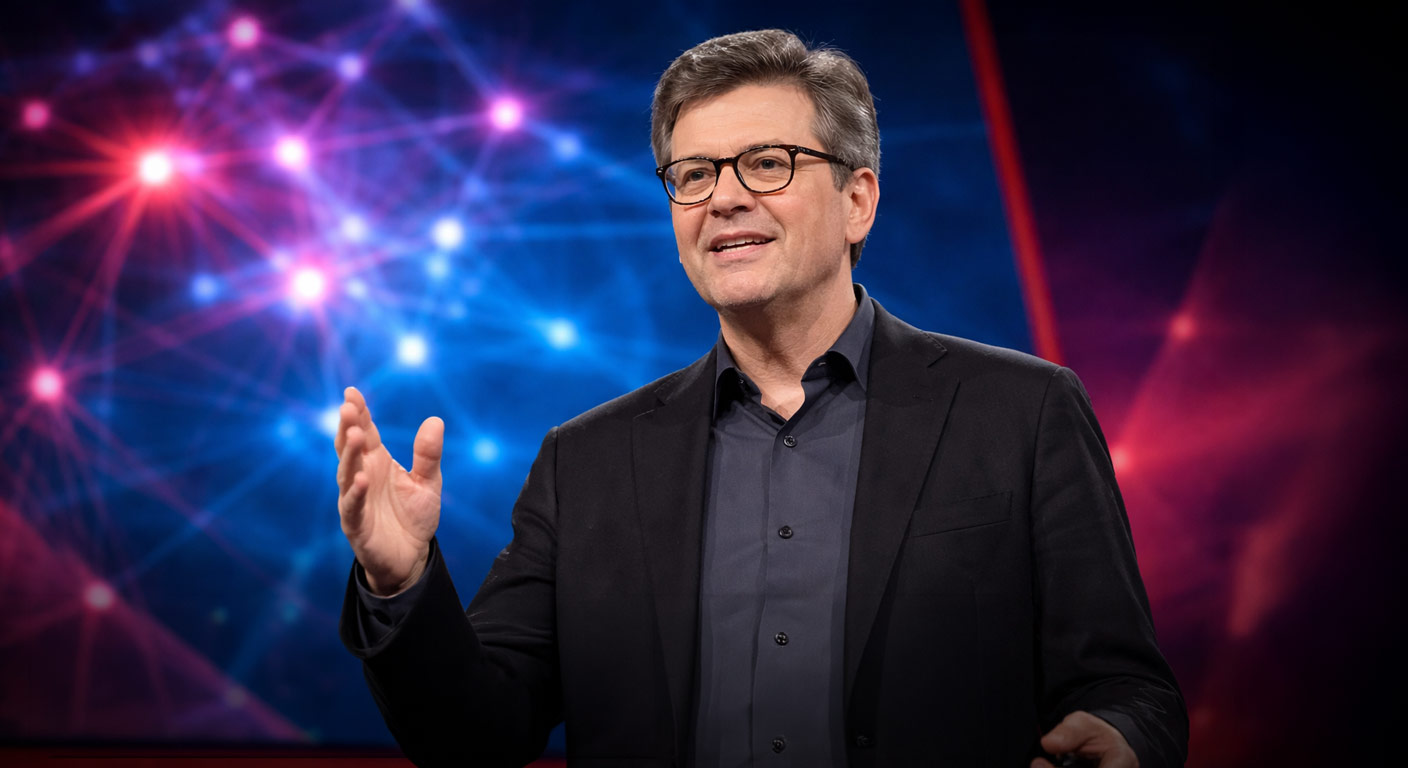

Yann LeCun discusses deep learning and the future of artificial intelligence during a TED Talk.
Artificial intelligence often feels like it moves in sudden bursts. One moment it's a research curiosity, the next it's quietly reshaping entire industries. Few people understand these shifts better than Yann LeCun, one of the foundational figures behind modern deep learning.
In his TED Talk, “Deep Learning, Neural Networks, and the Future of AI,” LeCun pulls back the curtain on how today's AI systems actually work - and, just as importantly, where their limits still lie. Rather than hype or fear, the talk is grounded in engineering reality: what neural networks are good at, why they struggle, and what breakthroughs might be required before we see truly intelligent machines.
This talk is especially relevant now, as large language models, generative images, and autonomous systems dominate headlines. LeCun's perspective acts as a much-needed anchor, reminding us that intelligence is not magic - it's architecture, data, learning, and constraints.
Who Is Yann LeCun - and Why His Perspective Matters
Before diving into the ideas themselves, it's worth understanding why LeCun's voice carries so much weight in AI discussions. Long before “AI” became a marketing buzzword, he was working on convolutional neural networks - the same core technology that now powers image recognition, computer vision, and many modern AI applications.
His work helped enable systems that can recognize faces, read handwritten text, identify objects in photos, and process complex visual information at scale. Today, LeCun continues to push AI research forward, particularly around self-supervised learning and machine perception.
That background shapes the tone of this talk. It's not speculative sci-fi. It's a practitioner's view of intelligence as something built, tested, broken, and rebuilt - not something that simply “emerges” because a model gets bigger.
If You want to know more about the furture of AI, you first need to know, How AI Thinks, we decode the processes of neural networksWhat Is Deep Learning, Really?
LeCun begins by demystifying deep learning itself. At its core, deep learning is about stacking layers of simple computational units - artificial neurons - that learn representations of data at increasing levels of abstraction.
Early layers might detect edges or simple patterns. Deeper layers combine those signals into shapes, objects, or concepts. This layered learning is what allows machines to recognize faces, understand speech, or classify images with remarkable accuracy.
Crucially, these systems don't rely on hand-coded rules. Instead, they learn from examples. Feed a network enough data, adjust its internal parameters through training, and it gradually improves its predictions. This shift - from programmed logic to learned behavior - is one of the defining changes in modern AI.
Why Neural Networks Excel at Perception Tasks
One of the strongest points LeCun (Visit Yann's X Profile) makes is that neural networks are exceptionally good at perception. Vision, speech, and pattern recognition are domains where traditional symbolic programming struggled, but deep learning thrives.
The reason is statistical. Real-world sensory data is noisy, incomplete, and ambiguous. Neural networks don't need perfect inputs - they learn probabilistic relationships across massive datasets, allowing them to generalize from imperfect information.
This is why AI systems can now identify objects in photos better than humans in some controlled tasks, transcribe speech in real time, and power recommendation engines that feel eerily intuitive.
To better understand neural networks you first need to understand what an AI Agent is, We help to explain AI Agents, Define The Types, & Provide Real World ExamplesThe Limits of Today's AI Systems
Despite these successes, LeCun is careful to draw a clear line between perception and reasoning. Modern AI systems may appear intelligent, but they lack a deep understanding of the world.
They don't possess common sense in the human sense of the word. They struggle with causal reasoning, long-term planning, and understanding physical reality beyond what they've statistically observed.
This distinction is critical. A neural network can recognize a cat in an image, but it doesn't understand what a cat is, why it behaves the way it does, or how it might interact with other objects in a real environment.
Why Supervised Learning Isn't Enough
LeCun also challenges the dominance of supervised learning - the method where models learn from labeled examples. While effective, supervised learning requires enormous amounts of human-curated data, which doesn't scale well to true intelligence.
Humans don't learn primarily through labeled examples. We learn by observing, predicting, and interacting with the world. Babies aren't given millions of labeled datasets - they infer structure from experience.
This is why LeCun advocates for self-supervised and unsupervised learning as the next frontier of AI. These approaches allow systems to learn directly from raw data, discovering patterns without explicit instruction.
AI Hallucinations Explained - Why Neural Networks Still Create FictionEnergy Efficiency and the Brain Comparison
Another striking contrast LeCun highlights is energy efficiency. The human brain operates on roughly 20 watts of power - less than a household light bulb - while training large AI models can consume vast computational resources.
This gap suggests that current architectures are still far from optimal. If AI is to approach human-level intelligence, it will need new learning paradigms that are both data-efficient and energy-efficient. Learn Why AI Uses So Much Energy >>
This isn't just an engineering concern; it's a practical one. Sustainable AI development depends on systems that can learn continuously without astronomical computational costs.
We examine the future of AI and look at The Top Trends Of 2026The Path Toward More General Intelligence
LeCun argues that true artificial general intelligence won't come from scaling today's models alone. Bigger networks and more data can push performance forward, but they won't solve fundamental gaps in understanding, reasoning, and autonomy.
Instead, progress will require new architectures that integrate perception, memory, prediction, and decision-making into unified systems. Machines will need internal world models - representations of how the environment works - rather than just pattern matching.
This vision places AI development on a longer timeline than some popular narratives suggest. Intelligence is not a single breakthrough away; it's an accumulation of many difficult advances.
Why This TED Talk Still Matters Today
LeCun's TED Talk holds up because it doesn't chase whatever AI trend is loudest this week. It focuses on fundamentals: perception, learning, representation, and the missing ingredients required for robust, general-purpose intelligence.
If you're building in AI, investing in it, or even just trying to understand what's real vs. hype, this talk is a useful calibration tool. It's optimistic, but not naive. It's technical, but approachable. And it reminds you that the future of AI is going to be shaped as much by what models can't do as by what they can.
Key Takeaways (Quick Summary)
- Deep learning works by learning layered representations from data, not hand-coded rules.
- Neural networks are strongest at perception tasks like vision and speech.
- Modern AI still lacks common sense, causal reasoning, and robust world understanding.
- Supervised learning is powerful but limited; self-supervised learning is a major next step.
- Efficiency matters - the gap between the brain and machines is still enormous.
- True general intelligence likely requires new architectures, not just scaling.
Watch the talk: If you want to experience LeCun's explanation in his own words, watch the full TED Talk and compare your takeaways with the themes above.
Get Better At Spotting AI By Playing The AI Image Guessing Game @ AiorNot.us