
Dating Apps • AI Photos • Fake Profiles
You don't need to be paranoid. You just need a better filter. Here are 10 real-world red flags - plus a simple verification routine - to spot AI photos, scripted chat, and classic scam tactics before you get pulled in.
Reading time:~12–15 minutes
Last updated:March 29 2026
Dating apps were already a little bit like shopping for fruit in a dimly lit grocery store: you pick things up, you squint, you do the sniff test, you put it back, and sometimes you take something home that looked better under the fluorescent lights. But now there's a new wrinkle: profiles that aren't just “polished,” but manufactured.
AI-generated photos and AI-assisted messaging didn't create deception - they industrialized it. Someone can spin up a face that looks real, build a convincing bio in 30 seconds, and run conversations like a call center. And because the face is “new,” it often won't show up in a reverse image search. That's the point.
Important: This guide isn't here to turn you into a conspiracy theorist who thinks every attractive person is a robot. The goal is simpler: help you notice patterns that show up in fake profiles, AI photo scams, and scripted catfish setups - and give you a quick way to verify safely.
If you want a quick way to train your instincts, play a few rounds of AI vs real images on AIorNot.us. It's the same muscle you use on dating apps: pattern recognition under uncertainty. Here is an article we did that takes a deeper look into the problem: Catfished By AI When Your Online Crush In Not Real
Why this is happening now
Three things converged at the same time:
- AI faces got good enough to pass the “first glance” test.
- Messaging got scalable (templates + AI rewriting + translation).
- Off-app channels got normalized (WhatsApp/Telegram/Signal) - which makes it easier to isolate targets.
Add the oldest ingredient in the book - loneliness - and you've got a high-converting funnel. The scary part isn't that AI is “too smart.” The scary part is that the tactics are predictable. They work because they target attention, emotion, and time pressure.
Rule of thumb: Fake profiles usually don't feel “bad.” They feel easy - like the conversation has no friction, like the chemistry is oddly instant, like the other person is permanently available, permanently flattering, and permanently pushing momentum forward.

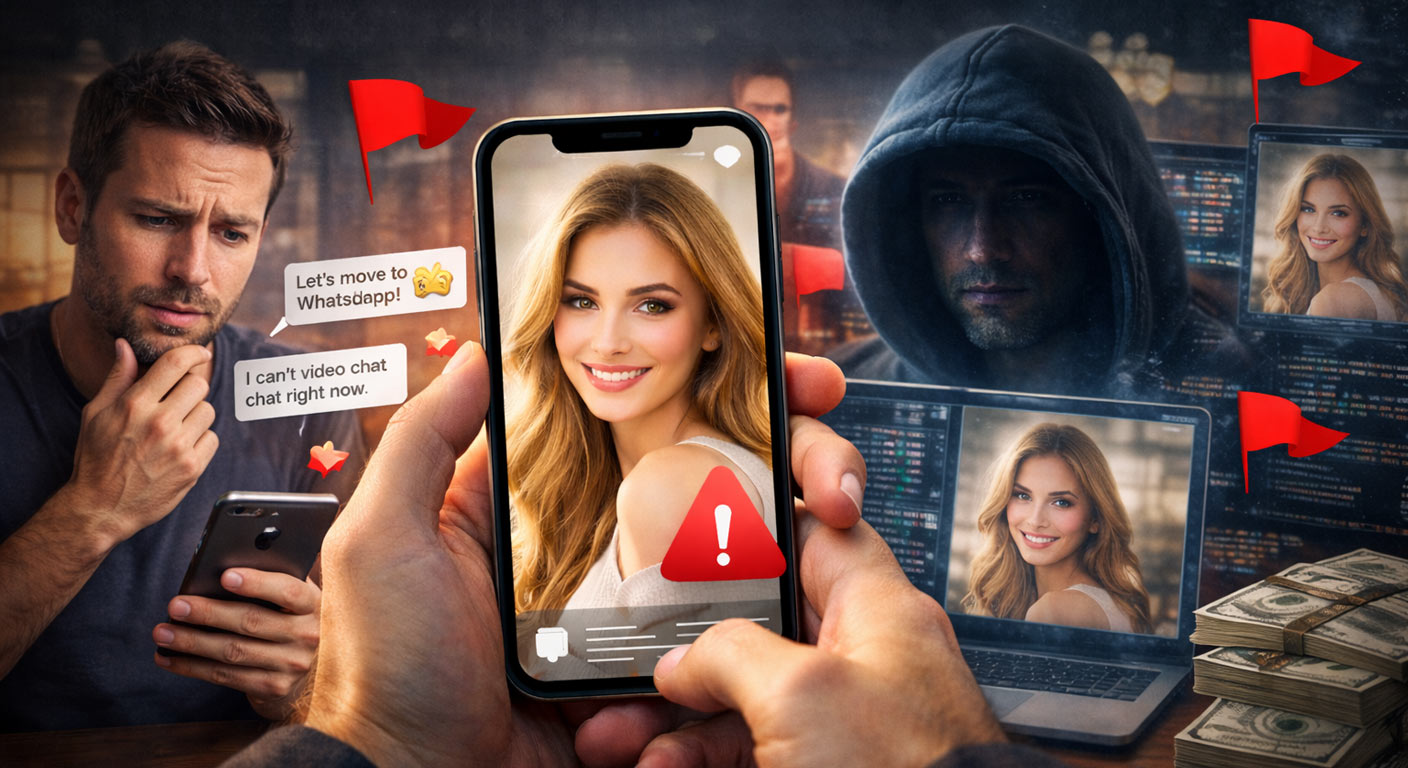
The 10 red flags (with examples)
You're not looking for one magical clue. You're looking for a stack of small signals that all point in the same direction. If you spot one red flag, pause. If you spot three, slow down. If you spot five… you're probably not in a love story. You're in a script.
1) The photos look “professionally perfect” - and weirdly consistent
Real people have messy camera rolls. Their photos range from “great lighting” to “why did I post that?” Fake profiles (and AI photo sets) often feel like a curated brand: same flattering angle, same smooth skin, same studio-ish lighting, same “this person is always camera-ready” vibe.
What it looks like: Every photo is a close-up face shot. Backgrounds are generic. No group photos. No awkward moments. No randomness.
Why it matters: Scammers want images that sell a fantasy and avoid details that can be verified (friends, locations, events, recognizable signage), and as we become more and more dependent on AI tools for thinking its getting easier for scammers to achive.
2) The profile feels “new” in a suspicious way
Minimal bio. Few prompts answered. No linked Instagram. A couple of generic interests (“travel,” “food,” “fitness”). Sometimes a brand-new account with one or two photos. You can't convict someone for being private - but you can treat it as a risk factor.
Watch the combo: New account + very attractive photos + immediate intensity in chat is a classic setup.
3) They dodge specific questions but respond fast
This one is sneaky because it feels like “good communication.” You ask something concrete - “Where in LA are you?” “What's your favorite place in your neighborhood?” - and they reply quickly… but vaguely. They might answer with emotion instead of information: “I love it here, it's such a vibe.” (Ways To Tell You Are Talking To A Bot)
Humans miss questions too, but fake profiles often avoid specifics because specifics are where lies collapse.
4) The conversation turns intense, fast
Compliments are normal. Interest is normal. But if it feels like you're getting love-bombed by someone who doesn't really know you, pay attention. Scammers and scripted accounts push intensity because it reduces your skepticism. Once you're emotionally invested, you'll rationalize things you wouldn't normally tolerate.
Hot take: “Fast feelings” can be real - but when they're paired with vagueness and off-app pressure, it's usually a tactic.
5) They want to move you off the app quickly
“I'm not on here much.” “The app is glitchy.” “Let's talk on WhatsApp/Telegram/Signal.” Sometimes they claim the app is “unsafe” while guiding you to a platform where reporting is harder.
Moving off-app is the moment they take you out of the platform's safety features. It's also where they can run the same script across multiple targets.
6) Reverse image search returns nothing - and that's presented as proof
A weird twist of the modern internet: no search results can be used as “evidence” that the person is real. But AI faces often have no online footprint. That absence isn't comforting - it's exactly what you'd expect.
Better interpretation: “No matches” means “no matches.” It doesn't mean “verified human.”
7) The photo details have little glitches (hands, text, backgrounds)
You don't need to zoom in like CSI. Just scan for the usual suspects:
- Hands/fingers: odd knuckles, fused fingers, jewelry melting into skin. (Why AI Struggles So Much With hands)
- Text: shirts or signs with letters that don't make real words.
- Background geometry: warped railings, crooked windows, repeating patterns that feel “generated.”
- Accessories: glasses arms that don't connect right, earrings that fade into hair.
AI has improved, but “clusters of weird” still show up. If you notice multiple small issues in one image, trust your eyes.
8) Their story has a “built-in excuse” for why you can't meet or call
Travel. Military. Oil rig. Contract work. “My camera is broken.” “I hate phone calls.” “I'm shy.” Again, any one of these could be true - but if they also avoid specifics and push urgency, it becomes a pattern.
Translation: If a person consistently prevents real-world verification, they're asking you to trust a narrative instead of evidence.
9) They introduce money or “opportunities” out of nowhere
This is where romance and crypto scams overlap. A “friend” who can teach you investing. A “special platform.” A side hustle. A job referral. Anything that feels like a pitch.
On dating apps, a sudden shift to finance is usually not a cute quirk. It's a conversion event.
10) They get angry, offended, or guilt-trippy when you try to verify
This might be the clearest red flag of all. When you politely ask for something reasonable - a quick video call, a selfie doing a specific gesture, a voice note saying your name - a real person might say “sure” or “I'm busy, later.” A scammer often flips the emotional script:
- “Wow, you don't trust me?”
- “I thought you were different.”
- “You're being disrespectful.”
- “If you really cared, you wouldn't ask that.”
That's not romance. That's pressure.
The 30-second verification routine
Here's the routine you can run without turning dating into an FBI operation. The point is to add just enough friction that fake profiles and AI image scams can't keep up.
1) Screenshottheir main photo + one “candid” photo.
2) Reverse searchwith Google Lens and one other tool. Any multiple identities = done.
3) Ask one specific questionthat requires local detail: “What's a place near you that everyone loves but you think is overrated?”
4) Request a quick proof: “Selfie holding up three fingers with today's date written on paper.”
5) Refuse urgency. If they push speed, you slow down on purpose.
Want to practice spotting AI photos? Run a few rounds on AIorNot.us. The goal isn't perfection - it's getting better at noticing patterns before your emotions do the driving.
Safe ways to verify without oversharing
Verification is important, but don't hand over your privacy in the process. A fake profile might push for personal details (your address, workplace, last name, financial situation). Keep your verification requests focused on their identity, not your data.
Good verification requests
- A short video call inside the app (if available) or a scheduled call with a clear time.
- A specific selfie with a gesture + date.
- A voice note saying your name and referencing something you asked about earlier.
Bad “verification” traps (don't do these)
- Sending photos of your ID, mail, bills, or anything with an address.
- Clicking “background check” links they send you.
- Sharing your personal phone number immediately if you don't need to.
- Installing apps to “verify” through their method.
Real people don't need your SSN to flirt. If the conversation moves toward “verification services” or personal documents, treat it like a smoke alarm. You don't debate a smoke alarm - you leave the building.
One of the best ways to avoid getting catfished online by AI is studing our guide to spotting AI ImagesWhat to do if you suspect a fake profile
If your gut is whispering “something's off,” you don't need a courtroom-level case. You just need to protect your time and your personal information.
- Stop moving forward until you verify. No off-app move. No money talk. No “quick favor.”
- Screenshot the profile and key messages.
- Report the account in the app.
- Block if they escalate pressure or get hostile.
- Tell a friend what happened. It helps you see the pattern clearly.
Also: beware of the “second wave.” If you cut off a scammer, you might get approached by a different account with a slightly different vibe. Some operations test multiple angles on the same person. It's not personal - it's a funnel.
Final gut check
The goal isn't to “win” the internet. The goal is to protect your time, your money, and your peace. If someone wants a real connection, they'll meet you halfway on basic verification. If they want control, urgency, secrecy, or favors… that's not romance. That's a transaction you didn't agree to.
FAQ's
Is every profile with a great photo AI?
No. Plenty of real people have great photos. The key is pattern: perfect photos + vague answers + fast intensity + off-app pressure is what raises the risk.
What if they refuse a video call because they're shy?
Shy is real. So is deception. Offer alternatives: a quick voice note, a specific selfie request, or a scheduled call later. If every option is declined and the excuses keep stacking, that's your answer.
Do AI photos always have obvious glitches?
Not always. Many AI images pass at a glance. That's why you combine image checks with behavioral signals (vagueness, pressure, off-app moves).
What's the safest way to verify someone early?
A short video call inside the app (if possible) is the cleanest option. If that's not available, a specific selfie request works well. Keep it simple and don't share your private information.
How can AIorNot.us help?
AIorNot.us helps you train your eye to spot common AI image patterns. Use it as a practice tool and combine it with the verification routine above.