
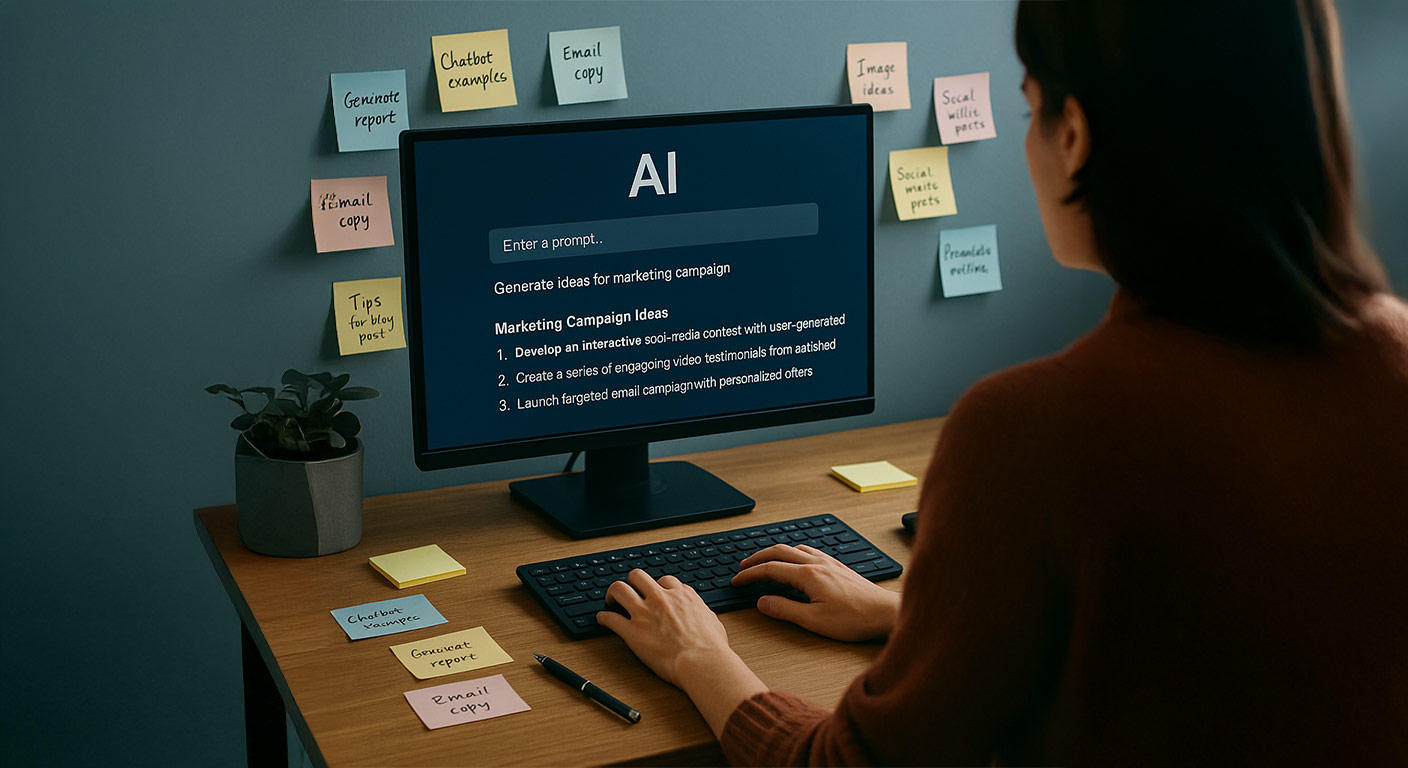

Picture the office 10 years ago. Someone who could not use email was not "quirky" - they were unemployable. Today, we treat prompting like a novelty, something only "AI people" care about. But we are not far from the moment where knowing how to talk to AI will be as normal - and as expected - as knowing how to send a calendar invite.
And here's the twist: prompting is not coding. It is communication. It is clarity. It is knowing what you want and asking for it in a way a machine understands. In other words - a soft skill. A human one. Which means anyone can learn it.
Prompting Is Just Giving Instructions - We Already Do That Daily
If you have ever ordered food at a restaurant, described a haircut, or told someone how to get to your house, you already understand prompting. The better the instructions, the better the result. Tell the barber “shorter” and you might walk out looking like a new recruit. Tell the barber “leave an inch on top, clean taper, keep the neckline natural” - they nail it.
AI works the same way.
Bad prompt: “Write my report.”
Better prompt: “Write a 3-paragraph report on Q4 revenue in a confident tone, include bullet points for key metrics and end with suggested action steps.”
One gets you a wall of generic text. The other gives you something you can actually use.
Once you understand the basics of AI prompting, the next step is learning how to get responses that actually sound like you. That usually means giving the tool better direction, clearer examples, and a stronger sense of tone, which is why these prompt training tricks for making AI write in your own voice can be so useful.
Why This Will Become a Core Skill (Not a Bonus One)
Companies do not want employees who stare at a blank page for 30 minutes when an AI can deliver a first draft in 10 seconds. They want people who know how to guide the AI - shape it, refine it, direct it. That is prompting.
Think about common workplace tasks:
- Drafting outreach emails
- Summarizing meetings or PDFs
- Brainstorming product ideas
- Writing job descriptions
- Creating slide decks or talking points
AI can assist with all of these - if the person at the keyboard knows how to ask. A well-prompted AI makes an average worker efficient. A poorly-prompted AI makes everything look robotic and bland.
Prompting isn't replacing skill. It is amplifying the people who already have it.
The Future Office Might Look Like This
- “Send me your prompts for this project.”
- “We need someone who can prompt better copy.”
- “Can you refine this prompt and reduce revision time?”
- “Let's standardize prompting templates for the team.”
These sentences sound foreign today. Soon they will not. We may look back at 2024-2026 as the era where early adopters quietly gained a massive advantage - like the people who learned Excel before everyone else caught on.
Not experts. Not engineers. Normal workers. The curious ones.
So How Do You Actually Get Better at Prompting?
You learn by doing - the same way we learned email. No course needed, no “AI guru” certification required. Just repetition and a willingness to explore. (You Can Even Enroll In An AI Prompting Course Online Here >>)
Here's a simple 3-step approach:
- Give AI context. Tell it who you are, what you need, who it is writing for.
- Define the output format. Bullets, email, script, summary, casual tone, formal tone.
- Refine instead of restarting. Say “shorter,” “more human,” “add humor,” “include stats.”
Treat it like a conversation instead of a vending machine.
Bad prompters demand results. Good prompters collaborate.
Knowing how to write effective prompts is only part of the equation. Employers are increasingly looking for candidates who understand how to use artificial intelligence to improve productivity, analyze information, and solve problems, which is why many experts now consider AI literacy a core workplace skill for long-term career success.
The People Who Learn Prompting Will Move Faster Than Those Who Don't
This is not about replacing creativity. It is about skipping the warm-up lap. No one ever won a race by choosing to start behind the line.
Prompting is leverage. It is speed. It is a multiplier on everything you are already good at.
In a world where everyone has access to AI, the advantage goes to those who know how to ask better questions.
Soon, being “bad at prompting” may sound as outdated as being “bad at email.” You do not have to master AI - you just need to speak its language well enough to work with it. And that skill will separate those who keep up… from those who get left behind.