
Why People Are Suddenly Asking This Question
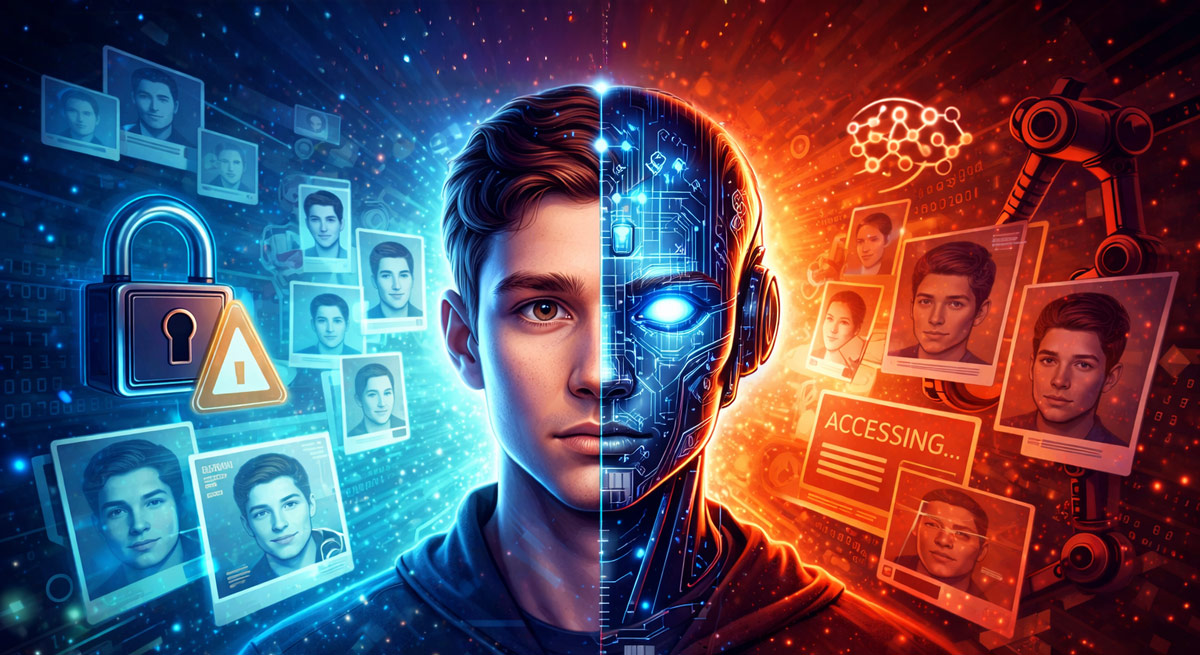
A few years ago, the idea that artificial intelligence could "steal your face" sounded like science fiction. Today, it feels uncomfortably realistic.
AI systems can now generate photorealistic faces, animate still photos, clone voices, and match identities across massive image databases. At the same time, billions of personal photos sit publicly accessible on social media, websites, blogs, forums, and old profiles people forgot existed.
The result is a growing sense of unease. People are asking whether AI companies are using public photos without consent - and what that means for privacy, identity, and trust. Digital Example: Grok Is Undressing Images Of Women!
What Does "Stealing Your Face" Actually Mean?
AI does not steal faces in the physical sense. What it does instead is collect, analyze, and learn from images of human faces. These images may come from:
Public social media profiles
Blogs, news articles, and personal websites
Stock photo libraries
Video platforms and livestream thumbnails
Public datasets compiled for research or training
When AI systems are trained on images, they don't remember "you" as a person. They learn patterns: facial structure, expressions, lighting, age markers, and identity features. Those patterns can later be used to generate new faces, match identities, or manipulate images.
That's where the ethical and legal questions begin.
How AI Uses Public Photos
1. Training Generative Models
Generative AI models learn what human faces look like by analyzing massive numbers of photos. These images help the model understand proportions, skin texture, symmetry, expressions, and age progression.
The model doesn't store your exact photo, but it may absorb characteristics that resemble you or people like you. That's why AI-generated faces can sometimes feel eerily familiar.
2. Facial Recognition and Matching
Some AI systems are designed to identify or verify identities by comparing facial features. This technology is used for:
Phone unlocking and device security
Airport and border screening
Surveillance and law enforcement
Social media photo tagging
When public photos are scraped into large datasets, facial recognition systems can sometimes identify people who never knowingly opted in.
3. Face Animation and Identity Manipulation
AI can now animate still images, generate deepfakes, and recreate faces in new contexts. Cool Photo Animation Tool >> A single photo can be enough to produce a convincing fake image or video under the right conditions.
This is where face usage crosses from abstract data collection into something that feels personal.
Good Read: Who Owns The Copyright On An AI Generated image?Is This Legal?
The legality of using public photos for AI training depends on jurisdiction, context, and purpose. In many places, publicly accessible images fall into a legal gray area.
Companies often argue that if an image is publicly available, it can be collected for training. Critics argue that visibility does not equal consent - especially when biometric data is involved.
Some regions treat facial data as sensitive biometric information, while others do not. Laws are struggling to keep pace with the technology.
This legal uncertainty mirrors broader questions we explore in our Understanding AI Images section.
The Risks of AI Using Public Faces
Loss of Privacy
Facial data is uniquely personal. Unlike a password, you cannot change your face. Once facial patterns are learned and reused, control is effectively lost.
Misidentification and Bias
Facial recognition systems have repeatedly shown accuracy gaps across race, gender, and age. Misidentification can lead to wrongful suspicion, exclusion, or harm.
Deepfakes and Identity Abuse
Faces scraped from public photos can be used to generate fake images, impersonations, or misleading content. When paired with hallucinated text or fake context, the result can become powerful misinformation.
This overlaps with the risks we outlined in our article on AI hallucinations and If AI Can Be Trained To Lie.
How AI Images Make This Even Harder to Detect
AI-generated faces often look completely real. (See Examples Of AI Generated Faces) They may not belong to a real person, or they may resemble someone whose photos were used during training.
This blurring of real and synthetic visuals makes it difficult to know:
Whether an image depicts a real person
Whether consent was given
Whether the image is altered or fabricated
If you want to train your eye to spot the difference, try the AI or Not image spotting game or browse real examples on Best AI Images.
Can You Protect Your Face From AI?
Limit Public Exposure
Reducing the number of publicly accessible photos lowers the chances of inclusion in scraping datasets. This includes old accounts and forgotten profiles.
Use Privacy Controls
Set social media profiles to private where possible and review platform permissions. While not foolproof, this adds friction.
Be Skeptical of "Free" Face Tools
Face filters, avatar generators, and "fun" AI tools often collect facial data. Always check terms of service before uploading images.
Support Regulation and Transparency
Long-term protection will come from clearer rules, consent requirements, and accountability for biometric data use.
So… Can AI Really Steal Your Face?
AI does not steal faces in the traditional sense. But it can absolutely use public photos to learn, replicate, and manipulate facial identity without explicit permission.
The technology itself is not inherently malicious. The risk comes from scale, opacity, and lack of meaningful consent.
As AI becomes more capable, understanding how your image is used - and what rights you have - becomes essential digital literacy.
Good Read: Learn The Visual Hallmarks Of An AI ImageFrequently Asked Questions
Can AI use my face if my photo is public?
In many regions, yes. Public availability often allows collection, though laws vary and are evolving.
Can AI recreate my face exactly?
Most systems generate approximations, not exact copies. However, with enough data, results can become very convincing.
Is facial recognition the same as AI image generation?
No. Facial recognition identifies or matches faces. Image generation creates new images based on learned patterns.
How can I tell if an image of a person is AI-generated?
Look for subtle visual inconsistencies and test your instincts using the AI or Not game.