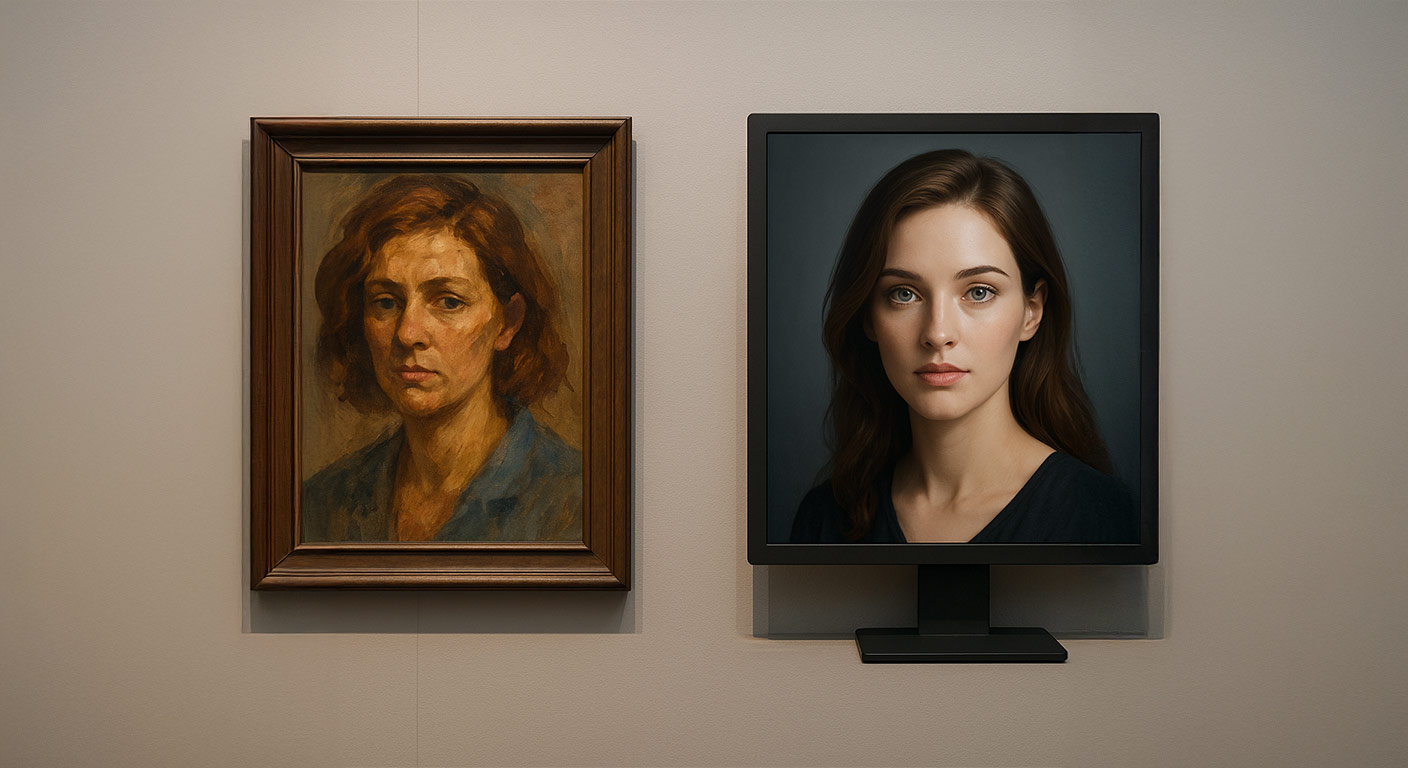

Not long ago, creativity was something sacred - slow brewed, deeply personal, full of flaws and fingerprints. A poem took a night of staring at a ceiling. A painting took a month of doubt. A novel? Years. Today, a machine can spit out a poem in five seconds, a painting in ten, and a novel outline before your coffee cools. So the question practically throws itself at us:
When machines can create faster than humans can think, does human creativity still matter?
It's a fair question - and one that's making artists nervous, companies excited, and the internet a chaotic mix of both. Some argue that AI is simply a new paintbrush. Others say it's the entire art studio, artist included. The truth, like most things, lives somewhere between the extremes.
Good Read: Why Humans Struggle To Distinguish Ai Images From Real OnesSpeed vs Soul - The Real Divide
AI is brilliant at **production**. It doesn't get tired, insecure, blocked, or distracted by Instagram. It generates 20 logo ideas in the time it takes a human to open Photoshop. But that speed doesn't guarantee meaning. It guarantees output.
There's a quote often attributed to Picasso:
“Computers are useless. They can only give you answers.”
Whether he truly said it or not, the spirit fits. AI gives answers - millions of them - but humans ask questions. Humans wonder. Humans scribble bad ideas until the good one finally lands like lightning. Machines remix. People originate.
It's the difference between **music that sounds perfect** and **music that feels lived in**. You can auto-generate a jazz solo, but it won't know heartbreak. You can have AI write lyrics, but it doesn't know what it means to miss someone so badly you write at 3AM to stay sane.
Real Example - AI Can Paint, But It Can't Live
Look at AI art competitions. In 2022, an AI-generated image won first place at the Colorado State Fair. It sparked outrage - not because the art was bad, but because it was good. Too good. The judge later said:
“I didn't know it was AI. The piece was beautiful - but knowing changes things.”
Why? Because behind a human painting is a life lived - late nights, failed drafts, heartbreaks, obsessions. Behind an AI painting is code and training data.
One artist posted online after losing to AI:
“It's not just the art. It's knowing someone poured themselves into it.”
That sentence is the entire debate in 11 words.
Good Read: Legality Explained, Who Owns The Copyright Of An AI Image?Machines Win at Output - Humans Win at Meaning
AI is a factory with infinite assembly lines. It wins when speed and scale matter. Need 200 ad headlines? Done. Want product descriptions for 5,000 SKUs? Easy. Machines crush the grunt work humans hate.
But give a machine the task of inventing jazz. Or writing Bohemian Rhapsody. Or capturing what grief feels like in a two-minute monologue. It can imitate - astonishingly well - but it doesn't know why the work exists.
Humans are messy. We contradict ourselves, break our own rules, fall apart, rebuild, and create from the wreckage. That chaos is where original art is born.
See The Best AI Images Of 2025 At AiorNot.USSo Who Wins in the Long Run?
It depends on how we define “win.”
- If winning means producing more → **AI wins.**
- If winning means creating faster → **AI wins.**
- If winning means moving the human spirit → **Humans win.**
- If winning means making us feel understood → **Humans win.**
The future likely belongs to the hybrid - the human who can **use AI without losing their voice**. The writer who lets AI brainstorm, then rewrites with scars. The designer who uses AI for drafts but adds the weird, personal touch only a life can teach.
One filmmaker said recently:
“AI can generate images. Only humans can generate meaning.”
That might be the compass that guides the next decade.
The Real Threat Isn't AI - It's Artists Who Never Use It
A machine can't replace human imagination, but it can replace someone who refuses to evolve. Just like cameras didn't kill painting, but painting without understanding photography suddenly looked… dated.
The winners won't be the purists or the fully automated studios. The winners will be the ones who hold the machine in one hand and their humanity in the other.
Try to guess which images are AI-generated versus human-made in our game:
👉 Play AI or Not
AI is the paintbrush. We're still the painter. And in the long run, it's not about the tool - it's about who has something real to say with it.