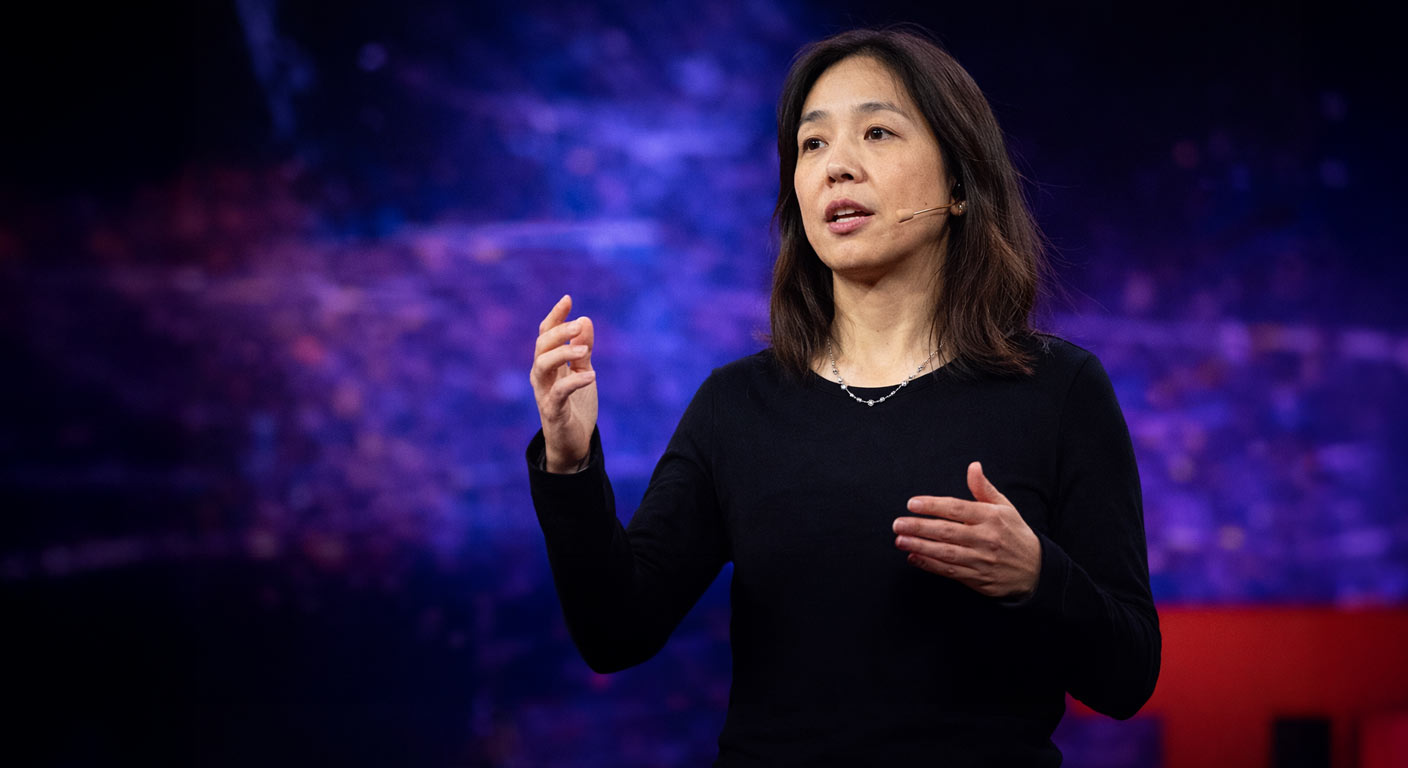

Fei-Fei Li argues the next leap in AI won't just be language-it will be spatial intelligence.
Some talks hit you with a “wow” moment. This one is more like a slow, confident click of gears-an idea you can feel settling into place. Fei-Fei Li isn't trying to convince you that AI is magic. She's making the case that modern AI, for all its fluency and flash, is still missing a core ingredient: the ability to truly understand the 3D world we live in.
Her TED Talk, “With Spatial Intelligence, AI Will Understand the Real World,” is a thoughtful argument for what's next: AI that doesn't just see images or generate text, but can interpret geometry, predict outcomes in space and time, and connect perception to action. In other words, AI that can do-not just describe.
If you've been following AI news lately, you've probably heard endless debates about chatbots, hallucinations, and whether language models “understand” anything. Fei-Fei Li takes a different angle. She basically says: even if language models get better, we won't unlock the full potential of AI until machines can build an internal model of the physical world-our world-and then interact with it safely and usefully.
The Opening: A World Without Sight (and Why That Matters)
The talk begins with a story that feels almost cinematic: the world 540 million years ago, full of light, life, and movement, but “dark” in a practical sense because there were no eyes. Li uses this as an analogy for where we are with machines today. We have plenty of data, plenty of computing, and plenty of algorithms-but we may still be missing a capability so foundational that we barely notice its absence.
She points to trilobites as early organisms that could sense light, and she links the emergence of vision to the Cambrian explosion (Understanding The Cambrian Explosion) the evolutionary moment when complexity and diversity in life took off. The takeaway isn't “biology is destiny.” It's that perception didn't just add a new feature to animals; it changed what was possible. Seeing led to insight, and insight made action smarter. That feedback loop, over time, became intelligence.
It's a strong opener because it sets up the entire thesis: the next big AI leap may not be another clever text model or another prettier image generator. It may be a fundamental upgrade in how machines perceive and represent reality. Learn the visual hallmarks of An AI image
A Quick History Lesson: The ImageNet Era and the Birth of Modern AI
Li then rewinds to her earlier TED appearance and the early momentum of computer vision. She describes the convergence of three forces: neural networks, GPUs, and big data-specifically, large curated datasets like ImageNet, which her lab helped build and popularize.
What's refreshing is that she doesn't frame that era as a fairy tale. It's practical: better algorithms + faster hardware + more data led to rapid improvements. Labeling images was once a milestone. Then the models got good enough to segment objects, track relationships, and build more nuanced interpretations of scenes.
This section functions like a reminder: AI breakthroughs often come from infrastructure and systems, not just clever ideas. And if spatial intelligence is the next frontier, it'll probably require new datasets, new training paradigms, and new evaluation methods-just like computer vision did. She goes on to mention why its so important to understand How AI thinks and decode the process of neural networks
From “Describe This Photo” to “Generate a World”
A fun moment in the talk is when Li recalls early work on image captioning-models that could describe a photo in natural language-done with her former student Andrej Karpathy. She jokes about asking him whether computers could do the reverse: take language and generate imagery. At the time, he laughed it off as impossible.
And then reality did what reality does in AI: it moved fast. Li points to diffusion models and the rise of text-to-image and text-to-video generation. She references how quickly “impossible” became possible, and she even throws in a classic TED-friendly joke about a video model that makes a cat's eye look wrong and has the cat sliding under a wave without getting wet. “Cat-astrophe,” she calls it. It's funny, but it's also the point: these systems are powerful, yet still imperfect at understanding physical consistency.
The bigger message here is subtle: generative AI is exciting, but generation alone isn't understanding. Pretty output isn't the same as a grounded model of reality. And if we want AI that can reliably operate in the world-robots, medical assistants, autonomous systems-we need more than clever pixels. The example Fei Fei gave was with AI hands and why Why AI still has such a hard time with human hands dispite how advance its become.
The Core Thesis: “Seeing Is for Doing and Learning”
This is the heart of the talk. Li says that taking a picture isn't the same as seeing and understanding, and then she pushes further: seeing isn't enough. Seeing is for doing, and doing feeds learning, and learning improves seeing. Nature built intelligence through a virtuous cycle of perception and action in 3D space and time.
She illustrates this with an everyday prompt: a picture of a glass near the edge of a table (the kind of image that makes you instinctively reach out). In a split second, your brain estimates geometry, balance, friction, the relationship between objects, and what might happen next. That instinct to act isn't random-it's spatial intelligence. It links perception to prediction to action.
Her suggestion is simple and big at the same time: if we want AI to move beyond “AI that can see and talk,” we need “AI that can do.” And doing requires machines that can build internal 3D models, understand physical relationships, and learn through interaction.
What “Spatial Intelligence” Looks Like in AI (So Far)
Li doesn't pretend this is solved. She emphasizes it's hard-nature took millions of years to evolve spatial intelligence. But she also highlights real progress: algorithms that reconstruct 3D environments from many photos, and models that can infer 3D shape from a single image.
The examples are important because they represent a shift from flat perception to structured world understanding. A system that turns photos into 3D space isn't just labeling pixels-it's learning geometry. A system that generates plausible 3D spaces from an image isn't just describing-it's modeling the unseen.
She also references research that maps text into a 3D room layout and work from Stanford that can take one image and expand it into “infinitely plausible spaces” for exploration. Even if you think “infinite” is a bit of TED-style poetry, the underlying idea is real: models are beginning to learn how to extend reality beyond the frame, which is a step toward world modeling.
Why This Matters: The “Digital Cambrian Explosion”
Li returns to her opening metaphor and reframes the present moment as a “digital Cambrian explosion.” Just like vision transformed life in the oceans, spatial intelligence could transform what digital systems can do-how they interact with humans, with each other, and with real or virtual 3D worlds.
This is one of the strongest parts of the talk because it connects the abstract (models, geometry, reconstruction) to the practical (robots, medicine, independence). It's easy to roll your eyes at grand metaphors, but her argument is grounded: if machines can't understand 3D space, they can't reliably operate in it. And a huge portion of human life is lived in 3D space.
Robotics: The Missing Link Between Intelligence and Reality
When she talks about robotics, you can hear the urgency. Robots are the ultimate “truth test” for AI. A chatbot can bluff its way through a bad answer. A robot can't bluff gravity.
Li notes that, historically, ImageNet helped train machines to see by providing a massive database of labeled photos. Now, she describes a similar effort for behavior-datasets and training approaches that teach machines and robots how to act in the world, not just recognize it.
This is a really important shift, especially if you run a site like AIorNot.us where readers are trying to separate “cool demos” from “real capability.” Spatial intelligence pushes AI from content generation into embodied learning. It's where AI must be consistent, safe, and grounded-because the real world is unforgiving. Lex Fridman dives into this point and AI consciousness in more depth.
The Most Memorable Application: Brainwaves Controlling a Robot Arm
The talk's most striking demo is a pilot study from her lab: a robotic arm cooking a Japanese sukiyaki meal, controlled only by non-invasive brain signals collected through an EEG cap. It's the kind of thing that makes your brain do a double take-part sci-fi, part deeply human.
And that's where her perspective lands: the point isn't “look how wild this is.” The point is empowerment. If spatial intelligence makes robots more capable, and if those robots can be guided by human intent-through interfaces that adapt to disability and limitation-then AI can expand human independence in ways that actually matter.
She also throws out other examples: robots transporting medical supplies so caretakers can focus on patients, and augmented reality guiding surgeons to operate more safely and less invasively. These aren't random futuristic fantasies-they're exactly the types of environments where spatial understanding is non-negotiable.
My Take: What This Talk Gets Right (and What It Leaves Open)
What I like most about this talk is that it's both optimistic and sober. Li doesn't claim we're “one model away” from embodied general intelligence. She frames spatial intelligence as a long arc-one that requires new data, new methods, and a careful commitment to human-centered design.
She also quietly challenges a common assumption in today's AI discourse: that language is the main highway to intelligence. Language is powerful, yes, but it's built on top of a body moving through a world. Humans don't just think in sentences-we think in space, motion, causality, and consequences.
The talk leaves open the hard questions that matter most: how we evaluate spatial intelligence, how we prevent unsafe behavior in robots, how we handle privacy when “the world becomes data,” and how we build trust. Li ends by acknowledging that getting this right requires thoughtful steps and human-centered technologies, not just raw capability.
Why This Is a Big Deal for the Future of AI
If you're tracking AI trends, spatial intelligence sits at the intersection of several big movements: world models, embodied AI, robotics, AR/VR, and simulation. It also exposes where current AI systems still struggle: physical consistency, causality, long-horizon prediction, and reliable interaction.
In other words, spatial intelligence is where AI stops being purely digital and starts bumping into the rules of reality. That's where the next decade gets interesting.
Quick Summary: The Core Points in One Minute
- Modern AI has made huge strides in vision and generation, powered by neural nets, GPUs, and datasets like ImageNet.
- Generation isn't understanding; making images or videos doesn't mean a model understands the physical world.
- Spatial intelligence links perception to action-it's how living beings predict outcomes in 3D space and time.
- AI needs spatial intelligence to operate reliably in the real world, especially in robotics and medicine.
- Early progress exists: reconstructing 3D from photos, inferring 3D from single images, and generating plausible 3D scenes from text or images.
- The goal is human-centered AI: useful tools and trusted partners that enhance dignity, safety, and prosperity.
Watch the talk: “With Spatial Intelligence, AI Will Understand the Real World” (Fei-Fei Li) Tip for AIorNot readers: As you watch, listen for how often she returns to the same loop-see → predict → act → learn. That loop is basically her definition of the next frontier. You can watch her full Ted talk in the video above, or via This Link >>
Quick Guide For Spotting AI Images Like A Pro Presented By AiorNot.US